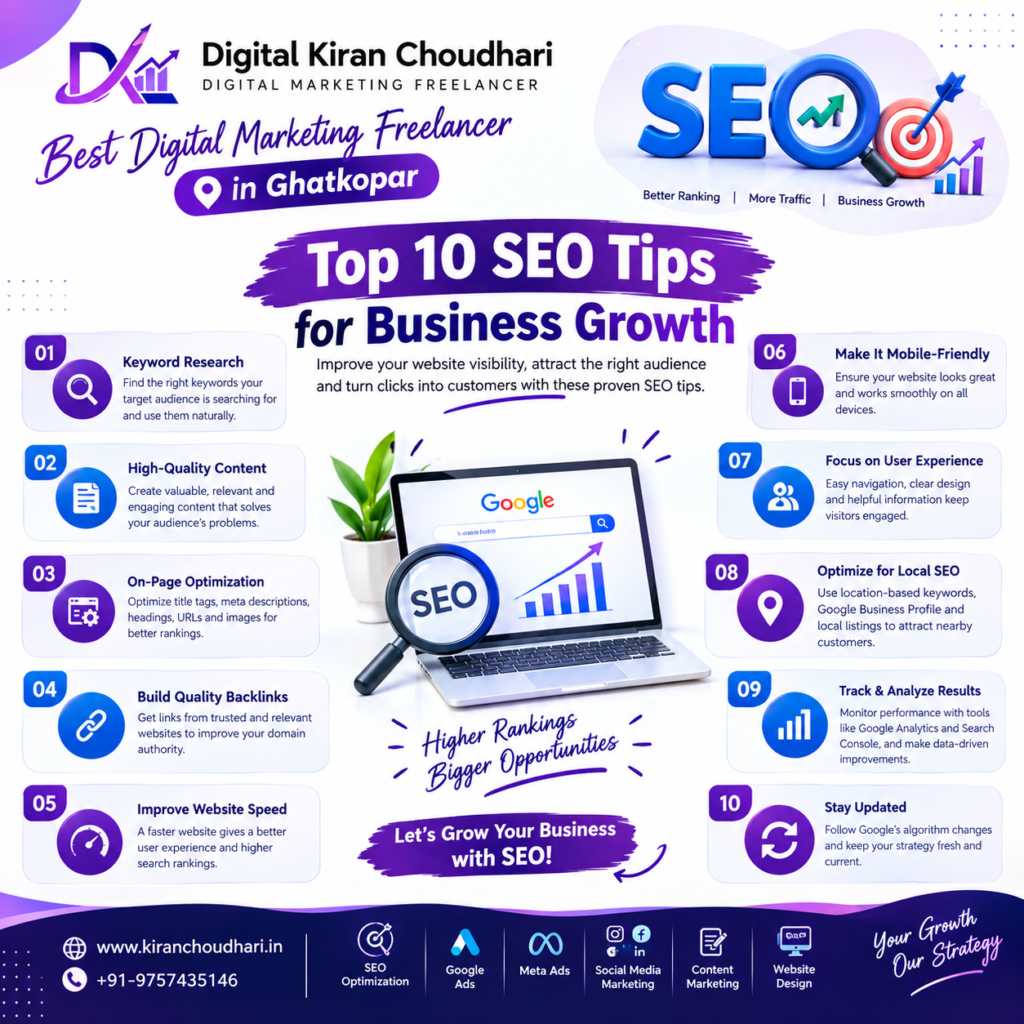
Top 10 SEO Tips for Business Growth: – Best Digital Marketing Freelancer in Ghatkopar
In today’s competitive online market, having a website is not enough to grow a business. Customers use Google to search for products, services, nearby businesses, and solutions to everyday problems. If your business does not appear in relevant search results, potential customers may choose a competitor instead. This is why Top 10 SEO Tips for Business Growth is an important part of a long-term digital marketing strategy.
SEO helps businesses improve their visibility on search engines, attract relevant visitors, build credibility, and generate potential leads. Whether you run a local shop, a service-based company, an online store, or a startup, a well-planned SEO strategy can support your business growth.
For businesses in Ghatkopar, Mumbai, local SEO can be particularly useful. Customers often search for services near their homes or workplaces, making location-specific keywords, accurate business information, and positive customer reviews important parts of online visibility.
Working with the Best Digital Marketing Freelancer in Ghatkopar can help you identify the right keywords, improve website performance, create useful content, and measure results. However, SEO is not an overnight process. It requires consistent effort, regular monitoring, and improvements based on actual performance.
In this guide, we will explore 10 practical SEO tips for business growth. You will learn how to optimize your website, improve local visibility, create helpful content, and turn search traffic into meaningful business opportunities.
What Is SEO and Why Does It Matter for Business Growth?
Search Engine Optimization, commonly known as SEO, is the process of improving a website so that search engines can understand its content and users can find useful information more easily. SEO includes keyword research, on-page optimization, technical improvements, content creation, and building a strong local online presence.
The main purpose of SEO is not simply to increase website traffic. It is to attract people who are genuinely interested in your products or services. For example, a customer searching for a digital marketing freelancer in Ghatkopar may be closer to contacting a service provider than someone searching for a general definition of digital marketing.
SEO can support business growth by improving online discoverability, answering customer questions, and creating more opportunities for inquiries and sales. Unlike paid advertising, organic search visibility does not require paying for every click, although SEO still requires time, expertise, and resources.
Results vary depending on competition, website quality, location, and the consistency of optimization efforts. A practical SEO strategy focuses on attracting the right audience and improving business outcomes rather than chasing rankings alone.
10 SEO Tips for Business Growth
1. Conduct Keyword Research Before Creating Content
Keyword research helps you understand what your potential customers search for on Google. Instead of choosing keywords based only on assumptions, identify the phrases people use when looking for your products, services, or solutions.
For example, a local service provider might target phrases such as “digital marketing freelancer in Ghatkopar,” “SEO services in Ghatkopar,” or “digital marketing for small businesses.” These keywords communicate different needs, so your content should match the searcher’s intention.
Use keyword research tools to explore search terms, related questions, competition, and potential opportunities. Group keywords by topic and purpose. Someone searching “what is SEO” needs educational content, while someone searching “SEO freelancer near me” may be looking to hire a professional.
Avoid repeating the same keyword unnaturally throughout a page. Use the main keyword in the title, introduction, a relevant heading, and other suitable places. Add related terms naturally where they improve clarity.
Action step: Create a keyword list for your main services and develop one useful page or article for each important customer need.
2. Optimize Your Website Titles and Meta Descriptions
Your page title and meta description help communicate what a page offers in search results. A clear title can make it easier for users to understand whether your page matches their needs.
Each important page should have a unique, descriptive title. Include the primary keyword where it fits naturally, and explain the page’s purpose. For example, a service page could use a title such as “SEO Services in Ghatkopar | Digital Kiran Choudhari.”
Write a meta description that summarizes the value of the page. Mention the service, relevant location, and a useful reason to visit. Avoid exaggerated claims, excessive keywords, or promises of guaranteed rankings.
Google may generate a different search snippet depending on the user’s query, so meta descriptions do not always appear exactly as written. Nevertheless, accurate titles and descriptions help establish clear expectations.
Also review your heading structure. Use one clear main heading, followed by relevant subheadings that organize the content logically. This improves readability and helps visitors find answers quickly.
Action step: Audit your homepage, service pages, and most important blog posts. Update titles and descriptions that are vague, duplicated, or unrelated to the page content.
3. Focus on Local SEO to Reach Nearby Customers
Local SEO helps businesses become more visible when customers search for services in a particular area. It is especially useful for businesses that serve customers in Ghatkopar and nearby parts of Mumbai.
Start by creating or improving your Google Business Profile if your business is eligible. Keep your business name, contact information, category, service details, and operating hours accurate. Add genuine photos and respond professionally to customer reviews.
Your website should also explain where you provide services. Create useful location-specific content when it genuinely helps customers, rather than publishing multiple pages with nearly identical information for different neighbourhoods.
Include your location naturally in relevant headings, service descriptions, and contact information. If you serve customers across several areas, clearly explain your service coverage without implying that you have a physical office in every location.
Reviews can help potential customers assess your business, although they do not guarantee higher rankings. Request honest feedback from real customers and never purchase fake reviews.
Action step: Review your business profile, check contact details, add recent photos, and make it easy for customers to contact you.
4. Publish Helpful, Original, and Relevant Content
Content marketing and SEO work well together when your content answers genuine customer questions. A useful blog can introduce your business to people who are researching a problem before making a purchase.
For example, a digital marketing website could publish articles about local SEO, Google Ads budgeting, website optimization, social media strategies, and measuring campaign performance. These topics address practical questions and can connect readers with relevant services.
Before writing an article, identify its main purpose and audience. Organize the information with clear headings, short explanations, examples, and actionable advice. Avoid adding unnecessary paragraphs simply to reach a particular word count.
Your content should offer something useful beyond repeating information already available elsewhere. Include your own process, practical examples, common mistakes, or a checklist that helps readers make decisions.
Review older articles regularly. Update outdated details, improve unclear explanations, fix broken links, and add relevant information when necessary.
Action step: Publish one well-researched article at a manageable frequency. Focus on usefulness, accuracy, and relevance rather than producing large amounts of thin content.
5. Improve Website Speed and Mobile Experience
A website should be easy to use on mobile phones, tablets, and desktop computers. Visitors may leave if pages load slowly, text is difficult to read, or important buttons are hard to find.
Start by testing your website with Google PageSpeed Insights. Review its recommendations for image optimization, loading performance, layout stability, and other technical issues. Results can vary between devices and testing conditions, so use the report to identify priorities rather than treating one score as the whole picture.
Compress large images, use modern image formats where appropriate, remove unnecessary scripts, and review your hosting and caching setup. Make sure your website uses HTTPS and that its navigation works properly on smaller screens.
Pay attention to the visitor’s next step. Contact forms should be easy to complete, phone numbers should be accessible, and service information should be clearly presented. A technically fast website still needs to provide a good user experience.
Action step: Test your five most important pages on a mobile device. Fix slow-loading elements, broken links, difficult navigation, and confusing calls to action.
6. Optimize On-Page SEO for Every Important Page
On-page SEO helps search engines and visitors understand what each page is about. It involves more than adding keywords: the page must provide clear, relevant information that matches the visitor’s purpose.
Choose one main topic for each page. Use the primary keyword naturally in the page title, main heading, introduction, and suitable supporting sections. Include related phrases when they fit the subject and help explain the service.
Write descriptive image alt text when an image communicates meaningful information. Use internal links to connect related articles and service pages. For example, a blog about local SEO could link to your SEO service page if the link helps readers take the next step.
Keep URLs readable and descriptive. Avoid changing existing URLs without a plan, because unnecessary changes can break links and affect search visibility. If a URL must change, use an appropriate permanent redirect.
Most importantly, make each page valuable on its own. A service page should explain what you offer, who it helps, what the process involves, and how a customer can get in touch.
Action step: Choose one high-priority service page and improve its title, headings, content, internal links, images, and contact options.
7. Build Relevant Internal Links and Earn Quality Backlinks
Links help users discover related information and can help search engines understand how your website’s pages connect. There are two important areas to consider: internal links and backlinks from other websites.
Internal links connect pages on your own website. For example, a blog explaining SEO basics can link to a detailed guide on local SEO or your relevant service page. Use descriptive anchor text so visitors understand what they will find after clicking.
Backlinks are links from external websites to your website. Relevant links from trusted, genuine sources can help strengthen your website’s authority and discoverability. You can earn them by publishing original resources, sharing useful research, contributing expert insights, and building legitimate professional relationships.
Avoid buying links intended to manipulate rankings, participating in link schemes, or submitting your website to irrelevant directories in bulk. These shortcuts can create risk without providing meaningful business value.
Quality matters more than simply counting links. A relevant mention from a respected local or industry website may be more useful than many links from unrelated sources.
Action step: Add helpful internal links to your existing content and identify a few legitimate industry or local opportunities for earning relevant mentions.
8. Use Google Search Console and Analytics to Measure Results
SEO requires measurement because rankings and traffic alone do not tell you whether your business is growing. Tracking the right metrics helps you understand what is working and where to focus your effort.
Google Search Console can show which search queries lead users to your website, the pages receiving impressions and clicks, and potential indexing or technical issues. Google Analytics can help you understand how visitors interact with your website and which channels bring them in.
For business growth, track meaningful outcomes such as completed inquiry forms, phone clicks, appointment requests, qualified leads, and sales where measurement is available. Compare results over time and look for patterns rather than reacting to every daily fluctuation.
If a page receives impressions but few clicks, review its title and description. If it attracts visitors but few inquiries, check whether the content matches the search intent and whether the next step is clear.
Action step: Set up measurement for your most important conversions and review performance monthly. Use the findings to decide which pages deserve improvement.
9. Strengthen Trust and Demonstrate Your Expertise
Customers are more likely to consider a business when they can understand its services, experience, and working process. Trust also matters for SEO content because visitors need reliable information that addresses their concerns.
Create an informative About page, provide accurate contact details, explain your services clearly, and use genuine testimonials or case studies when you have permission to share them. If you publish results, explain the context and avoid presenting one client’s outcome as a guaranteed result for everyone.
For service-based businesses, demonstrate expertise by explaining your approach. A digital marketing freelancer might describe how they conduct keyword research, review website performance, plan content, manage advertising campaigns, or report progress to clients.
Keep claims realistic. Avoid unsupported statements such as “number one on Google” or “guaranteed sales.” Explain what you can control, what depends on external factors, and how success will be evaluated.
Trust-building is not just about appearance. Your website should provide useful answers, protect customer information, and make communication straightforward.
Action step: Review your About, Services, and Contact pages. Make sure they accurately represent your experience, services, process, and business details.
10. Create a Consistent SEO Improvement Plan
SEO is an ongoing process, not a one-time task. Search behaviour changes, competitors update their websites, and new opportunities appear over time. A simple schedule helps you maintain progress without trying to change everything at once.
Start by identifying your business goals. You might want to increase qualified leads, attract local customers, improve product sales, or make a particular service easier to find. Select metrics that directly relate to those goals.
Prioritize work according to potential value and effort. Fix serious technical issues first, improve pages that already attract relevant visitors, create content for important customer questions, and review local business information regularly.
Keep a record of changes you make. If you update a title, improve a page, or publish a new article, note the date and monitor performance over the following weeks. This makes it easier to evaluate which improvements may have contributed to a change.
Avoid expecting immediate results. Some SEO improvements may take weeks or months to show meaningful effects, and results are never guaranteed. Consistency, useful content, and informed decisions are more sustainable than chasing shortcuts.
Action step: Build a 90-day SEO plan with a short list of priorities, monthly performance reviews, and clear measures of business success.
Common SEO Mistakes Businesses Should Avoid
Even a well-designed website can struggle to attract the right audience if important SEO fundamentals are ignored. Avoid these common mistakes:
- Keyword stuffing: Repeating a keyword excessively makes content difficult to read and does not create genuine value.
- Duplicate location pages: Publishing nearly identical pages for multiple areas can confuse visitors and provide little additional usefulness.
- Ignoring mobile users: Difficult navigation and poorly formatted content can prevent potential customers from contacting you.
- Buying suspicious backlinks: Manipulative link-building tactics can create unnecessary SEO risks.
- Ignoring analytics: Without measurement, it is difficult to determine whether your efforts are producing meaningful results.
- Expecting instant rankings: SEO requires time, maintenance, and ongoing improvements.
- Publishing content without a purpose: Every important page should help a specific audience answer a question or complete a task.
The best approach is to focus on the fundamentals and improve them consistently. A clear, helpful website supported by accurate information and useful content is a stronger long-term investment than shortcuts promising immediate results.
How a Digital Marketing Freelancer Can Help Your Business
Managing SEO alongside daily business activities can be challenging, particularly when you do not have an in-house marketing team. A digital marketing freelancer can help identify priorities, organize tasks, and implement improvements based on your business needs.
Support may include keyword research, website audits, on-page optimization, local SEO, content planning, technical recommendations, Google Business Profile improvements, and performance reporting. The exact scope depends on the freelancer’s expertise and the agreement.
Before hiring someone, ask about their process, deliverables, reporting frequency, and experience with businesses similar to yours. Request examples of previous work where available, and clarify what is included in the fee. Be cautious of anyone promising guaranteed rankings, a fixed number of leads, or instant results.
If your business operates in Ghatkopar, choosing a professional familiar with local search intent may help you develop more relevant content and service pages. However, location knowledge should be combined with a sound strategy, clear communication, and measurable goals.
Digital Kiran Choudhari offers a brand-focused option for businesses exploring digital marketing support. You can review the services and contact details on the website to decide whether the approach fits your requirements.
Website: https://kiranchoudhari.in/
Contact: +91-9757435146
Frequently Asked Questions About SEO for Business Growth
1. How long does SEO take to show results?
SEO timelines vary according to competition, website condition, content quality, and the work being done. Some improvements may be noticed within weeks, while meaningful growth in organic visibility can take several months or longer. There is no guaranteed timeline.
2. Is SEO useful for small businesses?
Yes. SEO can help small businesses appear for relevant searches, explain their services, and reach potential customers. Local SEO is particularly useful when a business serves a defined geographical area. Results depend on the market and the quality of the strategy.
3. How much does SEO cost in Ghatkopar?
SEO fees in Ghatkopar vary depending on the provider, project size, competition, and scope of work. A basic audit or limited local SEO project may cost less than ongoing SEO for a large website. Ask for a clear quotation listing deliverables, timelines, reporting, and additional charges rather than relying on price alone.
4. Can I do SEO without hiring a freelancer?
Yes. Business owners can learn keyword research, improve page titles, publish useful content, maintain their business profile, and monitor performance using available tools. Professional help may be useful when the website has complex technical issues or when you need a more structured strategy.
5. Does SEO guarantee first-page rankings?
No. No freelancer or agency can responsibly guarantee a specific Google ranking. Search results depend on many factors, including competition, relevance, website quality, and changes to search systems. Choose a provider who explains the process and measures progress honestly.
6. What is the difference between SEO and Google Ads?
SEO aims to improve organic visibility in search results, while Google Ads allows businesses to pay for advertising placements. Ads can provide visibility while a campaign is running, whereas SEO is generally a longer-term effort. Many businesses use both, depending on their goals and budget.
7. What should I track to measure SEO success?
Track organic clicks, search impressions, relevant keyword performance, qualified leads, calls, form submissions, and sales where possible. The most useful metrics depend on your business goals. Traffic is valuable when it reaches the right audience and contributes to meaningful outcomes.
Conclusion
Top 10 SEO tips for business growth can support sustainable business growth by helping customers discover your website, understand your services, and take the next step toward contacting you. The most effective strategy begins with clear goals and focuses on the fundamentals: relevant keyword research, useful content, optimized pages, local visibility, mobile usability, trustworthy information, and consistent measurement.
You do not need to implement all 10 SEO tips at once. Start by reviewing your website, identifying the pages most important to your business, and fixing the issues that may be preventing customers from finding or using them. Then build a practical schedule for content creation, local optimization, and performance reviews.
For businesses in Ghatkopar, a relevant local SEO strategy can help connect online searches with real customer needs. If you need professional support, consider working with a suitable digital marketing freelancer who explains their process, sets realistic expectations, and reports measurable progress.
Digital Kiran Choudhari provides a starting point for businesses exploring digital marketing services. call +91-9757435146 to discuss your requirements and decide on the next steps for your business.
Remember, the goal of SEO is not simply to rank higher. It is to help the right people find your business and make informed decisions.
About the Author

Digital Kiran Choudhari – Digital Marketing Freelancer in Ghatkopar, Mumbai
Digital Kiran Choudhari focuses on Top 10 SEO tips for buisness growth that help businesses improve their online presence and connect with relevant audiences. Areas of focus include Search Engine Optimization (SEO), Google Ads, social media marketing, Meta Ads, content marketing, and web development.
The approach emphasizes understanding business goals, selecting relevant keywords, improving website content, and evaluating performance using practical measures. Rather than relying on unrealistic promises, effective digital marketing involves planning, implementation, regular monitoring, and continuous improvement.
Businesses looking for digital marketing support can explore the services available at – contact +91-9757435146 to discuss their needs.