
Digital Marketing Tools to Increase Website Traffic : Guide by Digital Kiran Choudhari
Introduction
Getting more visitors to your website is a good start, but turning those visitors into potential customers is what really matters. Many businesses invest time and money in online marketing without knowing which activities deliver meaningful results. The right tools can help solve this problem by improving website visibility, understanding customer behaviour, creating engaging content, and generating qualified leads.Digital marketing tools to increase website traffic help businesses make informed decisions instead of relying on guesswork. From search engine optimization (SEO) and paid advertising to social media management and website analytics, each tool plays a different role in building an effective online presence.
I’m Digital Kiran Choudhari, a digital marketing freelancer focused on helping businesses strengthen their online visibility through SEO, Google Ads, social media marketing, and result-oriented digital strategies. In this guide, let’s explore useful tools, their benefits, and how to choose the right ones for your business.
What Are Digital Marketing Tools?
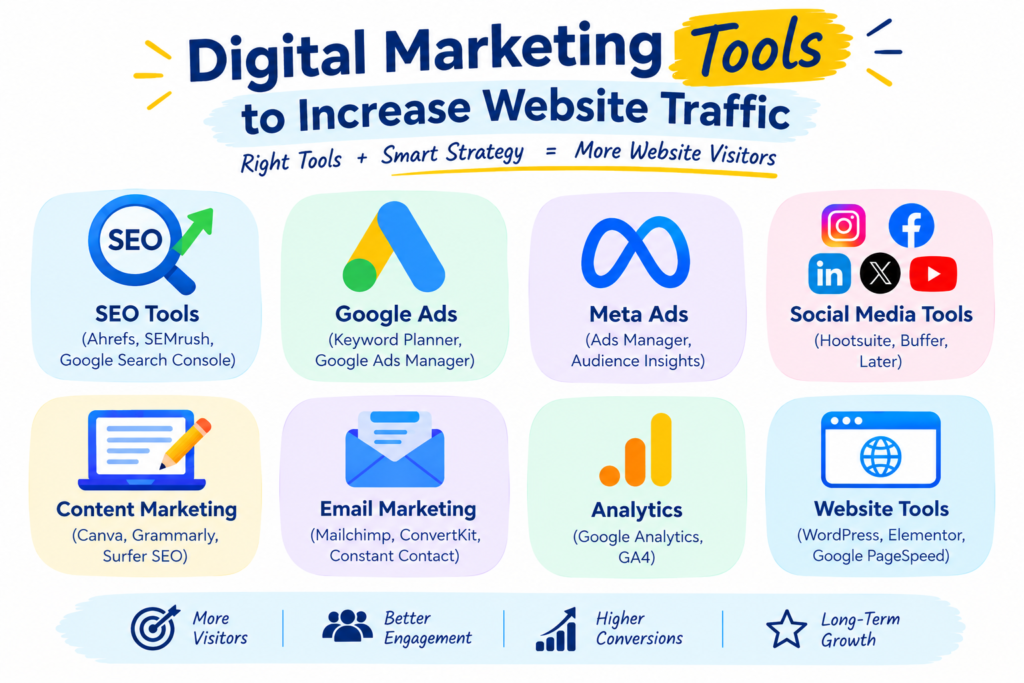
Digital marketing tools are online platforms and software applications that help businesses plan, execute, measure, and improve their marketing activities. They can identify relevant keywords, monitor website performance, manage advertising campaigns, schedule social media posts, and organize customer enquiries.
Instead of using every available platform, businesses should select tools according to their goals, budget, and target audience. A local service provider may prioritize Google Business Profile and SEO, while an online store may need analytics, email marketing, and conversion tracking.
The goal is simple: use reliable data and practical marketing methods to attract relevant visitors and encourage them to take action.
1. Google Search Console: Understand Your Website’s Search Performance
Google Search Console is an essential tool for website owners who want to improve their visibility in Google Search. It helps you understand which search queries bring visitors to your website and identify opportunities to improve your content.
How Google Search Console helps
- Shows search queries that generate impressions and clicks.
- Helps monitor indexing and discover certain technical SEO issues.
- Identifies pages that receive search traffic.
- Provides information about search performance and click-through rates.
For example, if a service page appears frequently in search results but receives few clicks, you can review its title tag and meta description. If a relevant keyword generates impressions, consider improving the page with useful information that matches the searcher’s intent.
Best for: SEO performance monitoring and organic website traffic.
2. Google Analytics 4: Turn Website Data into Better Decisions
Getting visitors to your website is only one part of digital marketing. You also need to understand what those visitors do after arriving.
Google Analytics 4 (GA4) helps you analyse user interactions, traffic sources, engagement, and configured conversion events.
How GA4 helps generate leads
- Identifies channels that bring visitors to your website.
- Helps measure important actions, such as form submissions and purchases, when correctly configured.
- Shows which landing pages contribute to business goals.
- Helps compare visitor behaviour across marketing channels.
Imagine your website receives traffic from organic search, paid advertisements, and social media. GA4 can help you evaluate how these channels perform when the relevant tracking is implemented correctly.
Practical tip: Track meaningful actions such as successful enquiry submissions, purchases, and qualified lead events. More visitors do not automatically mean more business.
3. Google Keyword Planner: Discover What Your Customers Search For
Before creating a blog or launching an advertising campaign, understand the words potential customers use when looking for your products or services.
Google Keyword Planner helps advertisers discover keyword ideas and explore estimated search volumes and advertising forecasts.
How to use it effectively
- Research keywords related to your services.
- Explore location-based keyword ideas.
- Identify search terms relevant to customer needs.
- Organize keywords according to search intent.
For example, a digital marketing freelancer serving Ghatkopar could research phrases such as “SEO services in Ghatkopar,” “Google Ads freelancer in Ghatkopar,” and “digital marketing services for small businesses.”
Use these phrases naturally in relevant website pages and blog posts. Choose keywords based on relevance, competition, and business value rather than search volume alone.
Best for: Keyword research and search advertising planning.
4. Google Trends: Identify Changing Customer Interests
Google Trends helps marketers explore how interest in a search term changes over time and compare related topics.
It can be useful when planning seasonal campaigns, selecting blog topics, or exploring differences in search interest across regions.
For example, a business can compare interest in different service-related terms before deciding which topic deserves more attention in its content calendar.
Remember that Google Trends generally shows relative search interest, not exact monthly search volume. Combine its insights with other keyword research data before making important decisions.
Best for: Topic discovery and trend-based content planning.
5. Semrush and Ahrefs: Strengthen Your SEO Strategy
SEO research platforms such as Semrush and Ahrefs help marketers investigate keywords, analyse backlinks, review competitors, and discover opportunities to improve organic visibility. Available features depend on the platform and subscription.
Benefits for website growth
- Discover keyword opportunities.
- Review competing websites and their content strategies.
- Monitor selected keyword rankings.
- Analyse backlink profiles.
- Identify potential content gaps.
Suppose a competitor receives organic traffic from useful articles that your website does not cover. Researching that topic can help you create a more helpful, original resource for your audience.
However, competitor research should inspire better content, not copying. Your content should offer original explanations, practical examples, and accurate information.
Best for: SEO planning, competitive research, and content improvement.
6. Google Ads: Reach People Ready to Take Action
Google Ads helps businesses display advertisements to audiences searching for relevant products and services or interacting with supported advertising placements.
It can be useful when a business needs targeted visibility while its organic search presence is still developing.
How Google Ads can generate leads
- Target relevant search terms.
- Direct users to specific service or landing pages.
- Measure advertising costs and configured conversions.
- Test different messages and offers.
- Adjust campaigns using performance data.
For example, a local service business could create a campaign targeting people searching for its services in a relevant area. The landing page should clearly explain the offer, demonstrate credibility, and make contacting the business easy.
Important: Set up conversion tracking, review search-term relevance, and monitor cost per lead. A large number of clicks is not useful if those clicks do not contribute to your business goals.
7. Meta Ads Manager: Generate Leads Through Facebook and Instagram
Meta Ads Manager helps businesses create and manage advertising campaigns across supported Meta placements, including Facebook and Instagram.
Unlike search advertising, which can reach people actively searching for something, social advertising can help businesses introduce their offers to relevant audiences based on available targeting options.
Useful applications
- Promote products and services.
- Generate enquiries through supported lead campaigns.
- Test different creatives and advertising messages.
- Reach relevant audiences using permitted targeting options.
- Retarget eligible audiences where supported and consent requirements are met.
For better results, use clear visuals, a relevant message, and a strong call to action. Ensure your enquiry process is simple and follow up with leads promptly.
Best for: Social advertising, brand awareness, and lead generation.
8. Canva: Create Content That Attracts Attention
Useful content needs to be easy to understand and visually appealing. Canva is a design platform that helps marketers create social media graphics, presentations, promotional materials, and other visual assets.
Ways Canva supports digital marketing
- Create blog graphics and social media posts.
- Design advertising creatives.
- Prepare branded promotional materials.
- Maintain a consistent visual identity.
- Develop simple educational graphics for customers.
For example, a blog about SEO can include a custom graphic explaining keyword research or website optimization. That graphic can also be adapted for social media to encourage people to visit the complete article.
Good design supports your message, but visual quality alone does not guarantee traffic or leads. Pair strong creative work with relevant content and a clear next step.
9. Buffer or Hootsuite: Manage Social Media More Efficiently
Managing multiple social media accounts can consume significant time. Social media management platforms such as Buffer and Hootsuite can help teams plan content, schedule posts, and review available performance insights.
Benefits of social media management tools
- Organize a content calendar.
- Schedule supported posts in advance.
- Maintain consistent publishing.
- Review engagement information.
- Coordinate social media activities.
A useful strategy is to turn one detailed blog into several smaller pieces of content. You could create a short tip, a carousel, a simple infographic, and a discussion question based on the same article.
This approach helps you reuse valuable information while adapting it to each platform’s audience and format.
Best for: Consistent social media publishing and content planning.
10. Mailchimp: Build Relationships Through Email Marketing
Not every website visitor is ready to become a customer immediately. Email marketing allows businesses to communicate with people who have voluntarily subscribed and agreed to receive relevant messages.
Mailchimp offers tools for email campaigns, audience management, and supported automation features.
How email marketing supports lead generation
- Share useful information with subscribers.
- Send relevant updates about products and services.
- Nurture interested prospects over time.
- Direct readers to useful website pages.
- Measure available campaign engagement metrics.
For example, a digital marketing freelancer could offer a practical SEO checklist in exchange for a voluntary email subscription. Subscribers could then receive helpful tips and relevant service information.
Always follow applicable privacy, consent, and email marketing requirements. Avoid purchasing email lists or sending unsolicited bulk messages.
11. Google Business Profile: Improve Local Business Visibility
For freelancers and businesses serving a specific area, Google Business Profile can support local discovery on Google Search and Maps, subject to eligibility and Google’s guidelines.
It is particularly relevant to businesses that meet customers in person or travel to serve customers at their locations.
Local marketing benefits
- Present accurate business information.
- Share services, updates, and relevant photos.
- Help customers discover your business locally.
- Collect and respond to genuine customer reviews.
- Make it easier for potential customers to find contact information.
For a freelancer targeting Ghatkopar, maintaining an accurate profile and publishing useful, locally relevant website content can support a broader local SEO strategy.
Do not add misleading locations or create fake reviews. Trust and accurate business information are essential for sustainable growth.
12. AI Tools: Speed Up Content Research and Planning
AI tools can assist with brainstorming, content outlines, headline variations, frequently asked questions, and campaign planning.
They can help marketers work more efficiently, but the final content still requires human judgment, fact-checking, originality, and a clear understanding of the audience.
Practical uses of AI in digital marketing
- Generate blog topic ideas.
- Develop content outlines.
- Brainstorm advertising messages.
- Create social media content variations.
- Summarize marketing performance for further analysis.
For instance, you can use an AI assistant to brainstorm ten blog topics around a service, then validate those ideas with keyword research and customer questions.
Avoid publishing generic AI-generated content without reviewing its accuracy or usefulness. The best results come from combining automation with real expertise and audience understanding.
How to Choose the Right Digital Marketing Tools
The right combination depends on your business model, objectives, budget, and available time. You do not need every tool mentioned in this guide to begin improving your marketing.
Consider these steps before investing:
- Define your objective: Decide whether you need organic traffic, paid leads, online sales, or stronger brand awareness.
- Understand your audience: Research the terms customers use and the problems they want to solve.
- Start with essential tools: Use relevant free tools before committing to several paid subscriptions.
- Set up measurement: Track meaningful actions such as qualified enquiries, calls, or purchases.
- Review results regularly: Identify which activities deliver useful business outcomes.
- Improve one step at a time: Refine your content, landing pages, and campaigns using evidence.
A simple, well-managed toolset can be more effective than an expensive collection of platforms that are rarely used.
Common Mistakes to Avoid When Using Digital Marketing Tools
Even the best software cannot compensate for a poorly planned marketing strategy. Avoid these common mistakes:
- Choosing tools without a clear business objective.
- Focusing only on website visits instead of lead quality.
- Publishing content without understanding search intent.
- Running paid campaigns without conversion tracking.
- Ignoring mobile website usability and page experience.
- Treating automated content as a replacement for expertise.
- Failing to follow up with genuine enquiries.
- Paying for features that your business does not need.
Remember, tools provide information and functionality. Results depend on how well you apply them to your customers’ needs.
Conclusion: Turn Digital Marketing Tools into Business Growth By Digital Kiran Choudhari

As Digital Kiran Choudhari, I believe successful digital marketing is not about using the maximum number of tools. It is about choosing the right tools, creating valuable content, measuring meaningful outcomes, and continuously improving your strategy.
Choosing the right digital marketing tools can help businesses improve their online visibility, understand their audiences, and build a more measurable process for attracting potential customers.
Start with a practical foundation: Google Search Console for search performance, GA4 for website analytics, keyword research tools for content planning, and suitable advertising or social media platforms for reaching your audience. Add more tools when a clear business need arises.
If your business wants to increase website traffic and generate more relevant leads, begin by identifying your biggest marketing challenge and selecting the tools that directly address it. Consistent, data-informed improvements can create a stronger foundation for long-term online growth.